

Recent research from Anthropic explores how artificial intelligence is beginning to reshape the global labor market using real-world data from millions of interactions with its AI assistant, Claude. Rather than relying on theoretical models, the study examines how people actually use AI in their daily work.
The results show that AI is already being integrated into a wide range of professional tasks, especially in knowledge-based roles such as software development, marketing, research, and customer support. These early patterns provide one of the clearest pictures yet of how AI is influencing productivity and job design across the economy. (Anthropic)
One of the most important findings is that AI is currently acting more as a tool that augments human work rather than replaces it. In many cases workers are using AI to accelerate tasks such as writing, coding, analysis, and documentation. The research suggests that AI performs best when paired with human expertise: the technology can generate drafts or solutions quickly, while humans refine and validate the results. This collaboration can significantly speed up complex tasks, highlighting how AI is evolving into a productivity partner rather than a direct substitute for workers. (Forbes)
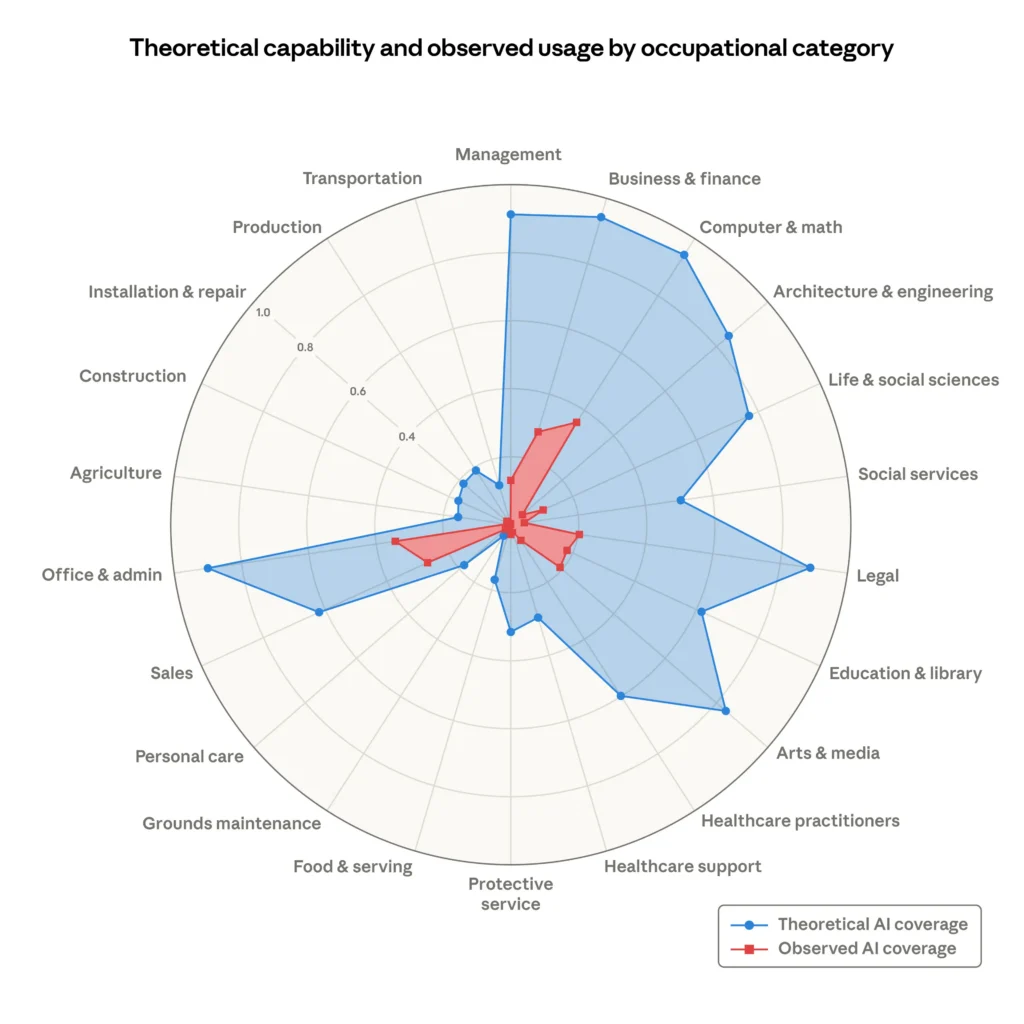
The report also shows that AI adoption is uneven across professions. Roles that rely heavily on text, analysis, and digital workflows are experiencing the greatest impact, while jobs requiring physical labor or interpersonal interaction remain less affected for now.
At the same time, the data indicates that AI tends to improve performance on complex knowledge work more than routine tasks. As a result, highly skilled professionals who understand how to work with AI tools may see the largest productivity gains, while organizations may need to rethink how tasks are structured across different occupations. (EdTech Innovation Hub)
Looking ahead, the research suggests that widespread AI adoption could significantly increase economic productivity over the next decade. Some estimates indicate that generative AI could raise labor productivity growth by roughly 1.8 percent annually if fully adopted across the economy.
However, the long-term effects on employment remain uncertain. While AI is currently helping people work faster and more efficiently, the technology may eventually transform entire job categories and create new forms of work that do not yet exist. (Anthropic)
Reference: Readers can access the full research report here: Anthropic: Labor Market Impacts of AI.