
As AI agents become capable of writing code, accessing enterprise systems, making decisions, and interacting with critical infrastructure, the conversation around AI safety is evolving rapidly. The question is no longer simply whether a model is safe. It is whether the entire AI system surrounding that model can be trusted.
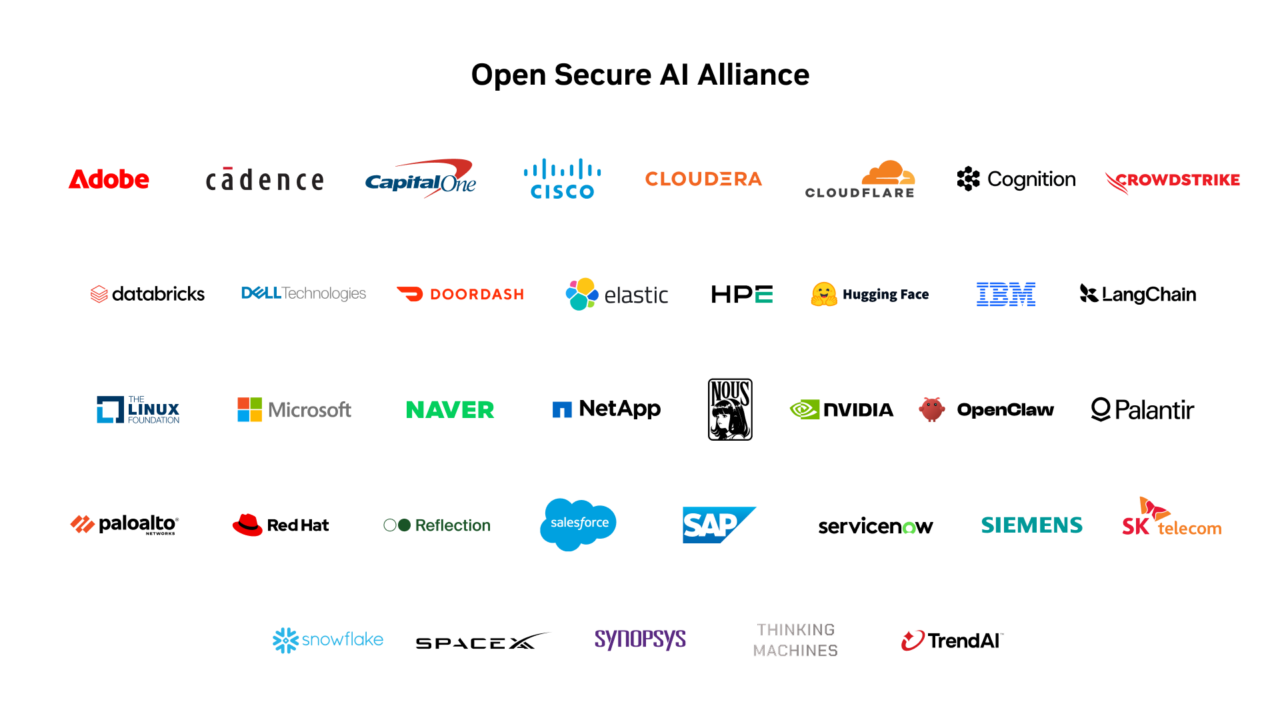
That shift has prompted the launch of the Open Secure AI Alliance, a new industry initiative bringing together many of the world's largest technology companies to build open standards, tools, and frameworks for securing AI systems.
Led by NVIDIA alongside partners including Microsoft, IBM, SAP, Cisco, Red Hat, Hugging Face, Dell Technologies, Cloudflare, Salesforce, ServiceNow, Snowflake, and dozens of others, the alliance represents one of the largest collaborative efforts yet focused specifically on AI security.
From Protecting Models to Protecting AI Agents
The announcement reflects an important evolution in how the industry thinks about AI safety. For much of the generative AI era, the focus has been on the language model itself. Companies invested heavily in guardrails, alignment techniques, and model evaluations designed to prevent harmful outputs.
The Open Secure AI Alliance argues that this is only one piece of the security challenge. Modern AI agents are complex systems made up of language models, orchestration frameworks, identity systems, permissions, memory, logging, evaluation pipelines, and security controls. A secure model running inside an insecure agent architecture can still expose an organization to significant risk.
"Real AI safety and security depend on the full agent stack—not just on whether model weights are open or closed." - NVIDIA
This reflects a growing consensus across the industry that securing AI requires protecting every layer of the system, not just the model itself.
Open Source Is Becoming a Defensive Advantage
One of the alliance's most important messages is that open AI should be viewed as a cybersecurity asset rather than a cybersecurity liability. For years, debate around AI has often centered on whether open models increase security risks by making advanced capabilities more widely available.
The alliance takes a different position. Open models, open evaluation frameworks, and open security tooling allow defenders to inspect systems, identify vulnerabilities, customize protections, and deploy AI within their own secure environments. Rather than relying entirely on proprietary cloud services, organizations can build security capabilities that remain under their own control.
"The world needs both closed and open models. For cybersecurity, open models and open harnesses are essential because they democratize defensive capabilities, increase transparency for defenders, enable cyber defense while protecting data, and complement frontier closed models with customizable, localized controls." NVIDIA
The argument is not that open models replace proprietary AI. Instead, both approaches serve different roles within a secure enterprise AI strategy.
A Real-World Example of Why It Matters
The alliance points to a recent security incident involving Hugging Face as an example of why open AI infrastructure can be critical during cyber incidents.
During the investigation, defenders needed to analyze more than 17,000 security events. Because commercial AI systems could not always distinguish legitimate forensic investigations from malicious activity, Hugging Face instead deployed an open-weight AI model inside its own infrastructure to accelerate the investigation and help contain the intrusion.
The incident demonstrated a practical lesson for enterprise security teams: during a cyberattack, organizations need AI systems they can inspect, control, and operate within their own trusted environments.
Building the Security Layer for AI Agents
Beyond advocating for open models, the alliance is developing technologies designed specifically to secure AI agents throughout their lifecycle.
Members are contributing capabilities that span the entire AI security stack, including identity verification, secure model formats, digitally signed software supply chains, AI-powered vulnerability scanning, and agent governance frameworks.
NVIDIA is contributing a new open research project called NOOA (NVIDIA Labs Object-Oriented Agent), designed to make AI agent behavior easier to test, audit, trace, and govern.
Other contributors are advancing complementary technologies, including Microsoft's multi-agent security scanning framework, Hugging Face's Safetensors model format, HPE's zero-trust identity framework, and IBM and Red Hat's digitally signed software supply chain technologies.
Together, these initiatives represent the early foundations of what could become a standardized security architecture for enterprise AI agents.
What This Means for Enterprise AI
As organizations move from AI assistants to autonomous AI agents, security can no longer be treated as an afterthought.
Businesses will increasingly need governance frameworks that verify AI identities, manage permissions, monitor agent behavior, audit decisions, protect sensitive data, and ensure AI systems remain compliant with organizational policies.
The Open Secure AI Alliance recognizes that achieving these goals requires collaboration across the technology industry rather than isolated efforts by individual vendors.
For enterprises, this could accelerate the development of interoperable security standards that reduce vendor lock-in while improving transparency and trust.
The Bigger Picture
The formation of the Open Secure AI Alliance highlights a broader shift in enterprise AI. The first generation of AI focused on building increasingly capable models. The next generation will focus on building trustworthy AI systems that organizations can confidently deploy into mission-critical environments.
Success will depend on far more than model performance. It will require secure identities, transparent governance, resilient infrastructure, standardized evaluation, and open security frameworks that enable organizations to verify how AI behaves in the real world.
The future of AI will not be secured by stronger models alone. It will be secured by building an ecosystem where intelligence, security, and trust evolve together.
Source: NVIDIA, Industry Leaders Unite in Open Secure AI Alliance for AI Safety and Security (July 27, 2026).