
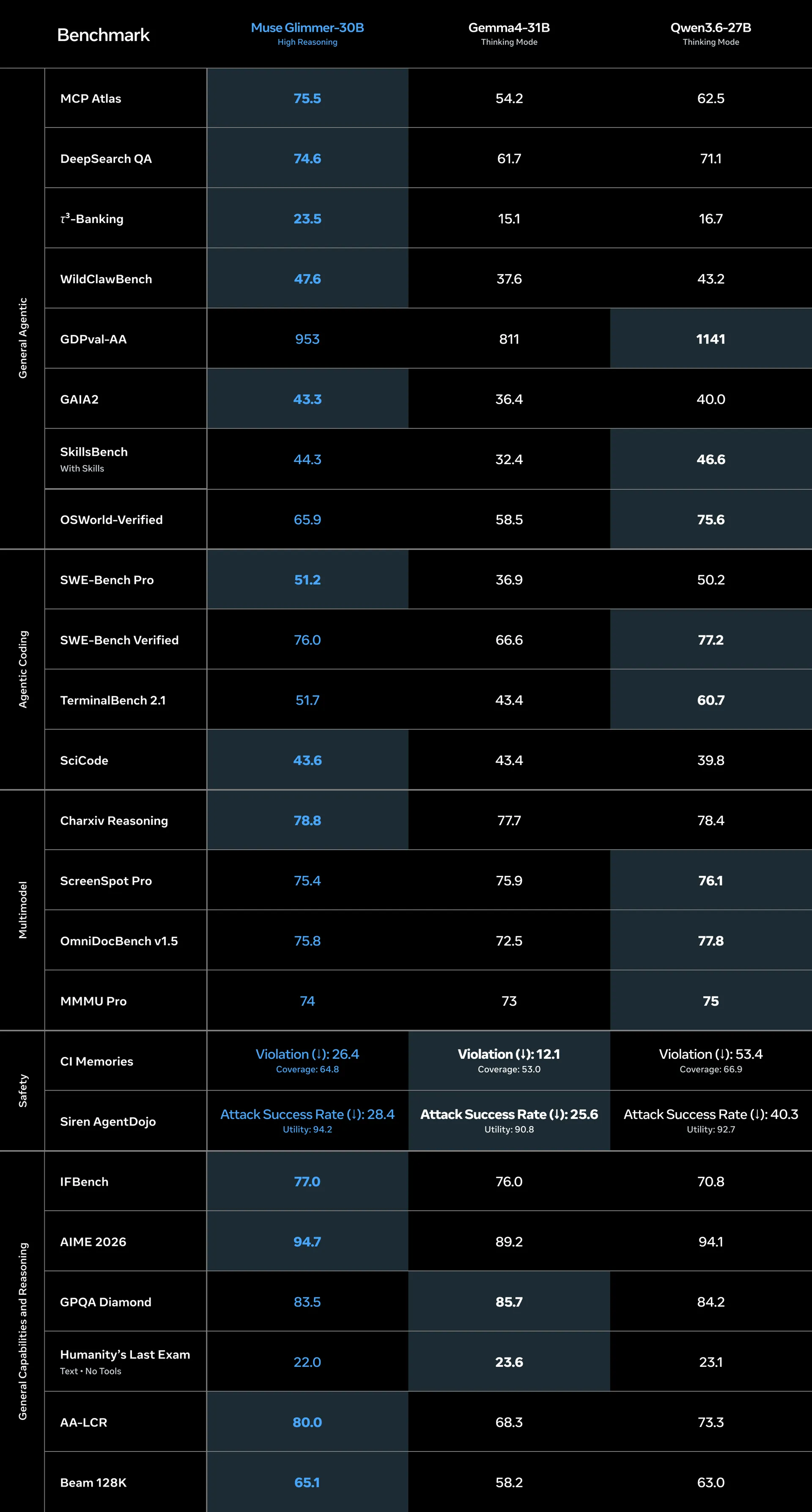
Meta has introduced Muse Glimmer, a 30-billion-parameter open-weight model designed specifically for always-on AI agents running locally on consumer hardware. Released under the permissive Apache 2.0 licence, the model is designed to run on a Mac or PC equipped with a single capable consumer GPU.
Rather than focusing primarily on chat, Meta has optimised Muse Glimmer for agentic workloads including tool use, multi-step reasoning, coding, function calling and autonomous task completion. The release represents another step toward AI moving beyond something users access through the cloud and becoming intelligence that can operate continuously on the devices and systems around them.
Why Local AI Matters
Most advanced AI applications today depend on cloud infrastructure, with requests sent to remote models, processed in data centres and returned to the user. Running capable models locally changes that relationship by allowing AI to operate without a permanent internet connection while potentially keeping sensitive information within the user's own environment.
For businesses, this could become particularly important. An AI agent responsible for managing schedules, accessing documents, analysing company information or interacting with internal systems requires deep access to organisational data, making greater control over where information is processed and stored increasingly valuable.
Built for Agents Rather Than Chat
Muse Glimmer's most interesting characteristic is its focus on completing work rather than simply generating responses. Meta trained the model across capabilities required for autonomous agents including long-horizon task completion, reliable function calling, multi-step reasoning and failure recovery. If a tool fails or produces an unexpected response, the model is designed to diagnose the problem and attempt another approach rather than simply stopping.
The model also supports multimodal inputs through a dedicated perception encoder, allowing agents to interpret screenshots, documents, charts and images alongside text. Muse Glimmer is designed to work with existing agent orchestration frameworks including OpenClaw, while multilingual training across more than 100 languages significantly expands the environments in which these agents could operate.
Making 30 Billion Parameters Practical
Running a 30-billion-parameter model locally presents a significant hardware challenge. At full precision, Meta says Muse Glimmer would require more than 55 GB of memory, putting it beyond the practical limits of most consumer systems.
Meta addresses this through quantisation, reducing the model's weights to approximately 4-bit precision and bringing the language model itself below 20 GB. This allows configurations to operate within a 24 GB or 32 GB memory envelope while leaving capacity for context memory, image processing and other components.
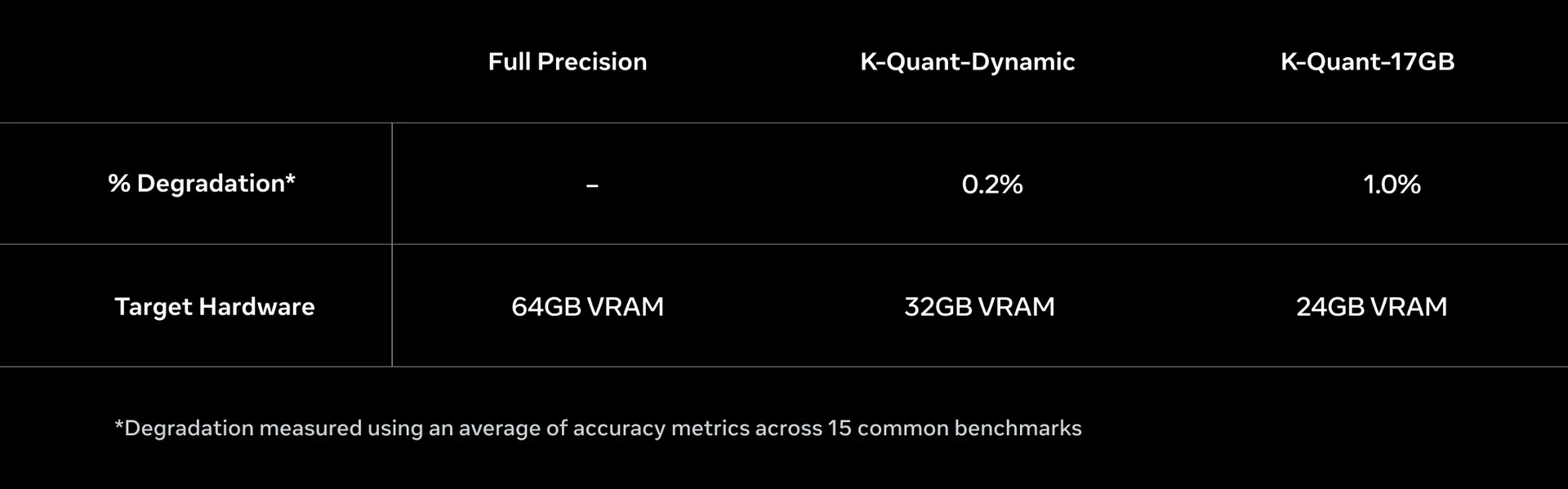
The significance is not simply that a large model can fit on a computer, but that increasingly capable AI can operate without requiring hyperscale cloud infrastructure for every interaction.
Making Local Agents Fast Enough to Work
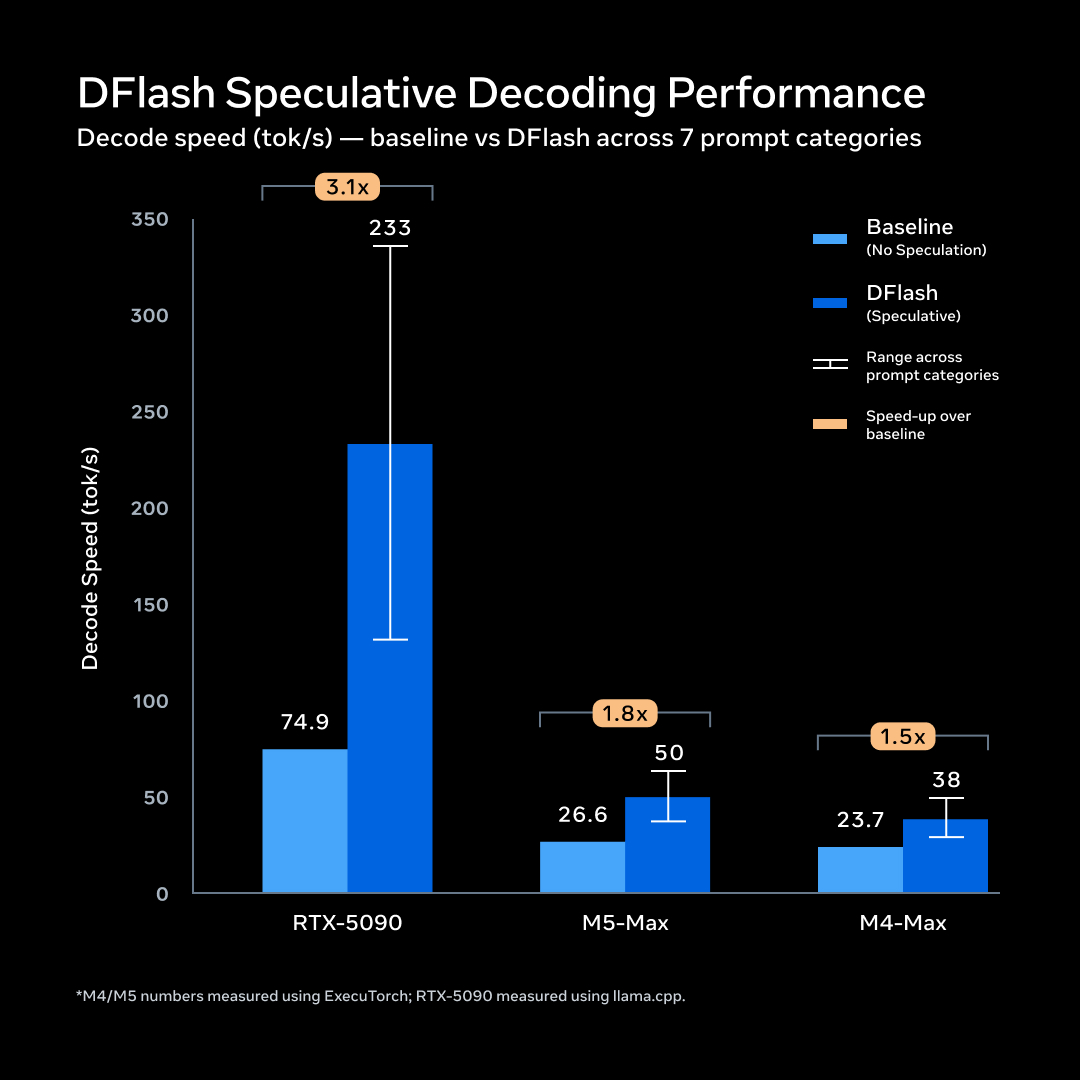
Capability alone is not enough for an agent expected to participate continuously in everyday work. If every action requires a long reasoning cycle, the experience quickly becomes impractical, so Muse Glimmer uses speculative decoding through a lightweight companion model based on DFlash to accelerate generation.
Glimmer offers low, medium, high and xhigh reasoning settings — set via the system prompt — so applications can dial reasoning effort up or down per task, and Meta says it works across agentic scaffolds including OpenClaw and Hermes Agent.
Instead of generating every token sequentially, the smaller model proposes blocks of tokens that Muse Glimmer can verify in parallel. Meta says this significantly increases generation speed without changing output quality and has tested its 17 GB quantised configuration across Apple's M4 Max and M5 Max hardware as well as Nvidia's RTX 5090, targeting speeds suitable for fluid conversations and real-time agent interactions.
Open Weights Could Be Just as Important
Meta is releasing Muse Glimmer's model weights under Apache 2.0 rather than restricting access to a proprietary API, giving developers and businesses considerably greater freedom to deploy, customise and fine-tune the model for specialised applications. Support is planned across tools and frameworks including llama.cpp, MLX, ExecuTorch, Ollama, LM Studio, vLLM and SGLang, while Meta is also working with AMD, Arm, Dell, Intel and Nvidia on hardware optimisation.
This ecosystem approach could prove important because businesses do not all require the same AI. A logistics company, accounting firm, restaurant group and manufacturer each have different processes, terminology, data and operational requirements, and open local models provide another path toward creating AI that is increasingly specific to the organisation using it.
From Personal Agents to Company Agents
Meta positions Muse Glimmer heavily around personal agents, but the same technological shift has potentially larger implications for businesses. An AI agent with access to a company's processes, operational data, documents and internal tools could perform an increasing amount of its work within infrastructure controlled by the organisation itself rather than sending every interaction to an external service.
The result could be a new generation of private company agents capable of monitoring operations, analysing information, coordinating workflows and completing tasks continuously. For SMEs in particular, increasingly efficient local models could eventually make sophisticated private AI capabilities accessible without requiring businesses to build their own foundation models or maintain enormous computing infrastructure.
The Economics of Intelligence Are Moving to the Edge
There is a broader technological trend behind the release. Frontier AI development continues to demand enormous data centres and increasingly powerful computing infrastructure, while smaller models are simultaneously becoming dramatically more capable.
The two trends are closely connected. Large models can increasingly act as teachers, transferring capabilities into smaller and more efficient models through techniques such as distillation. Muse Glimmer itself uses this approach, learning from outputs generated by Meta's larger Muse Spark model, creating a pathway for intelligence developed using enormous infrastructure to eventually be compressed and deployed much closer to the user.
What Muse Glimmer Means for the AI-Powered Workforce
Muse Glimmer is ultimately interesting because it demonstrates how quickly the boundary between cloud AI and local AI is changing. A 30-billion-parameter model capable of reasoning, seeing, using tools, recovering from failures and executing multi-step workflows can now be compressed to run on high-end consumer hardware.
For businesses, the next stage of AI adoption may therefore be less about employees accessing increasingly powerful chatbots and more about organisations deploying persistent AI agents that understand their data, processes and objectives. The cloud will remain essential for the largest models and most computationally demanding tasks, but increasingly capable local models create another layer of intelligence that is private, persistent and positioned much closer to where work actually happens.
That combination could prove to be an important building block for the emerging AI-powered workforce.
Source: Meta Superintelligence Labs — Introducing Muse Glimmer: An Open Agentic Model
https://research.meta.ai/blog/introducing-muse-glimmer-open-agentic-model