


For the past several years, the AI industry has been dominated by a simple assumption: the most powerful models require massive cloud infrastructure. If you wanted advanced reasoning, coding, multimodal capabilities, or agentic workflows, you typically needed access to expensive data centers and powerful GPUs running somewhere else.
Google DeepMind is challenging that assumption with the release of Gemma 4 12B, its latest open model designed to bring advanced AI capabilities directly to consumer devices. Combined with the Google AI Edge ecosystem, the model enables coding, data analysis, voice editing, multimodal understanding, and agentic workflows to run locally on everyday laptops.
The significance of this release goes beyond another model launch. It represents a growing movement toward on-device AI, where intelligence runs locally rather than relying entirely on cloud infrastructure.
AI Without the Cloud
One of the biggest advantages of Gemma 4 12B is that users can perform sophisticated AI tasks while keeping their data entirely on their own machine. Documents, voice recordings, code repositories, and personal workflows never need to leave the device. In a world increasingly concerned about privacy, security, and data ownership, this approach offers a compelling alternative to cloud-based AI services.
This is becoming increasingly valuable as businesses and consumers grow more cautious about uploading sensitive information to third-party platforms. For many organizations, particularly those handling confidential or regulated data, local models could be the difference between experimenting with AI and deploying it at scale. The ability to combine advanced capabilities with complete data control is quickly becoming a major competitive advantage.
From Chatbot to Agent
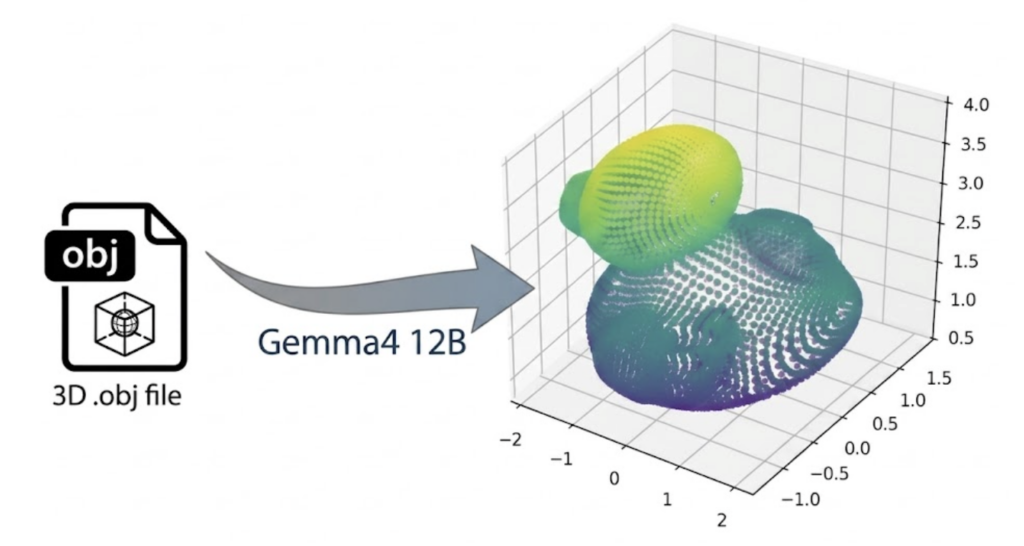
Gemma 4 12B is not positioned as a traditional chatbot. Instead, Google is showcasing its ability to function as a practical agent capable of executing real-world tasks. Through Google AI Edge Gallery, users can describe objectives in natural language and have the model generate code, execute scripts, analyze datasets, and create visualizations directly on the device.
In demonstrations, the model was able to generate Python programs, render charts, process data, and even handle complex coding workflows with minimal user intervention. This reflects a broader shift happening across the AI industry.
The focus is moving away from systems that simply answer questions and toward systems that can perform meaningful work on behalf of users. The future of AI may be less about generating text and more about completing tasks.
Voice Becomes a Workflow
Google is also extending Gemma’s capabilities through AI Edge Eloquent, a fully local voice dictation and editing platform. Rather than simply transcribing speech, users can issue natural language commands such as “turn these notes into an executive summary” or “translate this paragraph into Hindi,” and the model performs the transformation directly on the device.
This points to an emerging vision where voice becomes a primary interface for interacting with AI. Instead of opening applications, navigating menus, and manually editing documents, users can simply describe what they want and allow intelligent systems to handle the execution. For knowledge workers, this has the potential to significantly reduce friction across daily workflows while improving productivity.
The Rise of Local AI Infrastructure
Perhaps the most strategically important announcement is the expansion of LiteRT-LM, Google’s lightweight local runtime. The new serving capabilities allow Gemma 4 12B to function as a local AI endpoint that can integrate with developer tools, frameworks, and autonomous agents without relying on external APIs.
The implications are substantial. Every laptop has the potential to become its own AI platform, capable of supporting coding assistants, research agents, automation tools, and productivity systems while maintaining complete control over data and costs. In many ways, this mirrors the early evolution of cloud computing, except the intelligence layer is now being pushed back to the edge rather than centralized.
A Different Vision of the AI Future
The AI industry is currently obsessed with larger models, larger data centers, and larger infrastructure investments. Every month seems to bring announcements of billion-dollar facilities and ever-increasing compute requirements. Gemma 4 12B offers a different vision—one focused on delivering powerful AI experiences efficiently on hardware people already own.
That question may become increasingly important as AI adoption scales. Businesses care about performance, but they also care about privacy, cost, responsiveness, and operational simplicity.
Local AI addresses many of those concerns simultaneously, making advanced intelligence accessible without requiring continuous cloud connectivity or escalating infrastructure costs.
The Bigger Picture
Gemma 4 12B is not simply another open model release. It is part of a larger shift toward decentralizing AI and distributing intelligence closer to users. For years, the industry assumed that the future of AI would live inside massive data centers controlled by a handful of technology companies.
The emergence of increasingly capable local models suggests a different future—one where intelligence is distributed across millions of devices rather than concentrated in a few cloud providers. If that vision becomes reality, the next major AI platform may not be a cloud service at all. It may be the laptop sitting on your desk.
Source: Google DeepMind and Google AI Edge announcements for Gemma 4 12B, AI Edge Gallery, AI Edge Eloquent, and LiteRT-LM (2026).