






Sammy Collins twists and pulls on a directional drill’s controls. The former Marine uses the lurching, 15,000-pound vehicle to bore a path through the soil for future fiber-optic lines.
About 40 other members of his crew are sprinkled across this rural corner of Apache County, digging ditches, hanging fiber cables on utility poles and joining tiny fiber strands.
Collins, 36, previously worked at an addiction treatment facility but was sick of his desk job. So he joined this crew six months ago, notched two promotions and boosted his pay by more than 22%. Experienced drillers can make anywhere from the high $20s to mid-$40s per hour, up to double the statewide median hourly wage
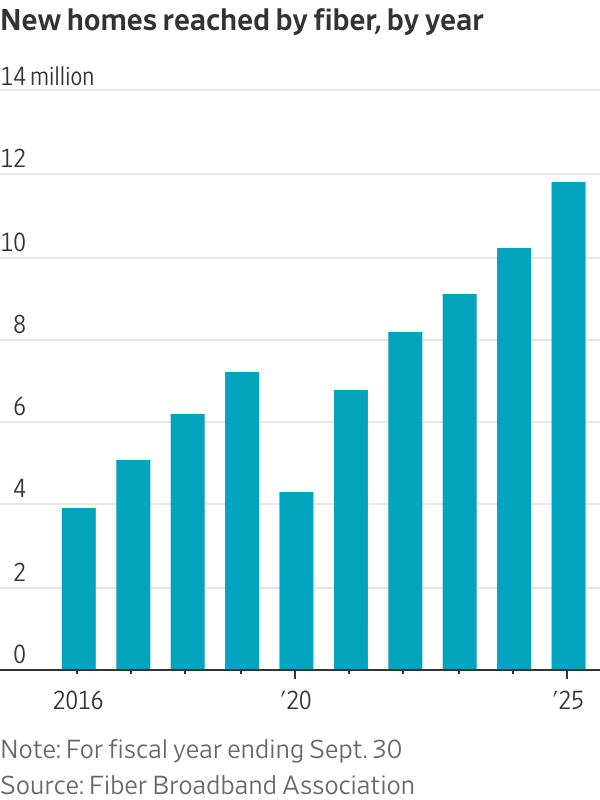
Fiber cables were laid at a record-high number of homes last year, fueled by billions in federal grants for broadband internet. Tech companies’ voracious appetite for data centers is ratcheting up demand further, with the need for millions more miles of cables.
Yet the rush to build is hitting a human bottleneck, particularly among workers who can piece together the fiber networks at the heart of the technology. Some jobs take months of training or an artist’s attention to detail; others require the physical strength and stamina to climb telephone poles in summer heat. Crews can’t hire fast enough, and when they do, workers often are poached by competitors dangling higher wages.
“We just don’t have the people to do the work,” said Kyle Braude, a former rodeo rider who now manages fiber build projects for JKL Associates, a subsidiary of utility-construction contractor Push. The biggest holdup in the fiber boom, he said, is human capital for roles including drillers, foremen, splicers and aerial linemen.
The demand is expected to create 58,000 new jobs between 2025 and 2032, according to a 2024 report by the Fiber Broadband Association and the Power & Communication Contractors Association. With 120,000 workers expected to leave the field in the same period—mainly through retirement—the report forecasts a combined shortage of 178,000 workers. As a result, contractors and analysts predict that our AI future might take longer to achieve and that a goal of nationwide high-speed internet could remain out of reach.
For those with fiber-laying skills, the work can pay good money, no college needed. Telecommunications line installers and repairers made annual median wages of $70,500 for the year ended May 2024, the latest figure available, according to the Bureau of Labor Statistics. That figure doesn’t include overtime pay. By comparison, the annual median wage across all occupations nationwide was $49,500.
Push raised hourly wages for fiber crews by 5% to 8% in each of the past several years, and expects pay to rise even faster in the near future, said Chase Lapcinski, Push president.
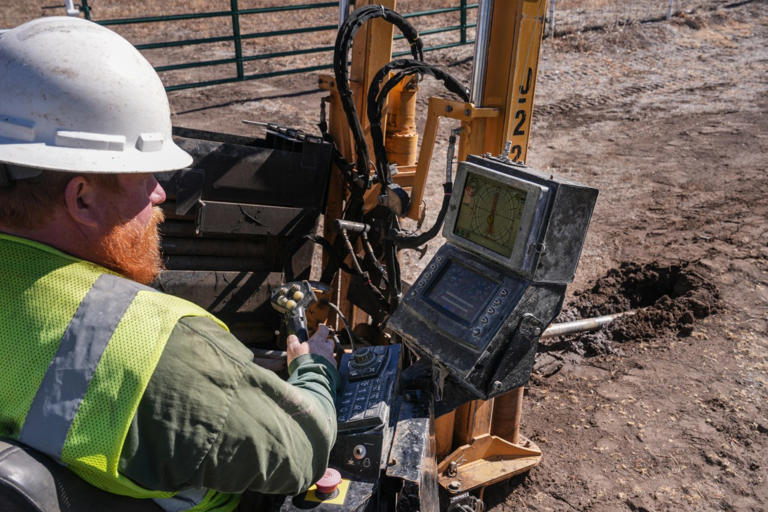
Sammy Collins, a directional drill operator, boring a hole for a fiber-optic cable conduit to run through.

Kyle Braude, a regional manager at JKL Associates, shows a piece of fiber-optic cable.© Paul Ratje for WSJ
Entry-level fiber workers at Jonesburg, Mo.-based Sellenriek Construction made about $60,000 including overtime last year. That can jump by 25% to 30% in the first three years, said Chief Executive Steve Sellenriek, and site superintendents can make six figures. Sellenriek said he is seeing an unprecedented rush of clients trying to lock in contracts early, before wages rise even further.
Many workers join crews without prior fiber experience, the way Collins did. Others take training courses before getting hired. Learning Alliance in Tampa, Fla., offers a six-week to eight-week boot camp, funded by military benefits and corporate donations, that trains students to install fiber.
The program’s 2025 graduates made about $26 an hour in starting pay, plus overtime, said Cesar Ruiz, Learning Alliance’s president and CEO. He has seen that rate increase by about 13% in two years.
The job isn’t for everyone. Fiber crews often work more than 10 hours a day outdoors in nearly all weather. They may relocate to a project area for months at a time. And winter can bring less work in parts of the country, because of challenges drilling through snow and frozen ground.
Mitch Grant, a 38-year-old fiber splicer with K&S Communications, has been spending time lately kneeling over green utility pedestals in small town Springerville, Ariz. Most locals there don’t have high-speed fiber internet, and he says they are eager to get connected—so eager, they stop him at work and ask for updates. (The service, provided by Commnet’s Ethos Broadband, is expected to be in place within two to four months.)
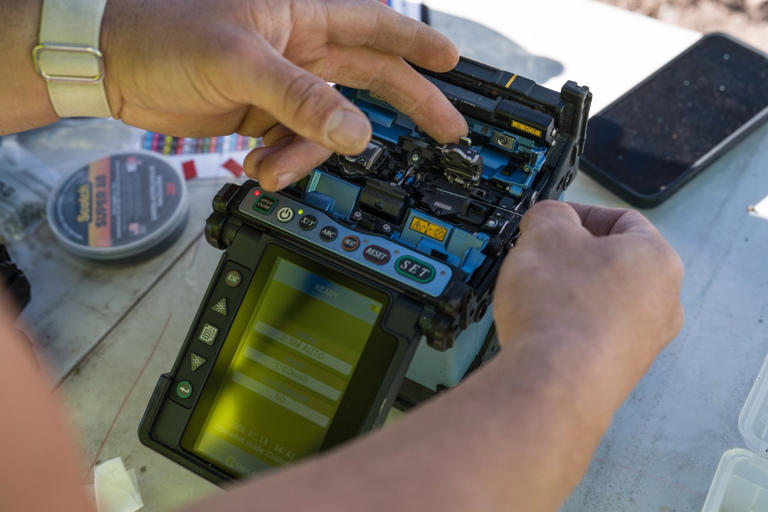
Fiber splicer Mitch Grant demonstrating how to connect fiber-optic cables using a splicing machine.
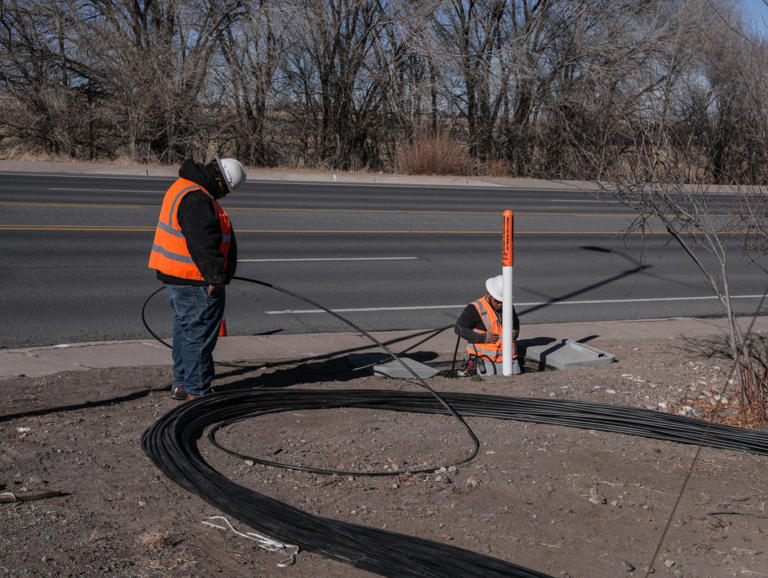
Technicians feeding fiber-optic cable underground.
Grant’s work is delicate: He cleaves each strand of a fiber-optic cable for a clean edge, then uses a machine to fuse the hair-thin filaments, which carry digital data at the speed of light. A slight misalignment, or even a speck of oil from the technician’s hands, and the strands won’t join.
“When you first start doing it, it’s like, ‘How can you possibly do it?’ But then you get muscle memory,” Grant said. Four years ago, he left cell tower work to manage fiber crews, then saw how much this particular specialty makes—sometimes upward of $30 per splice for projects like this—and moved into that role. He sometimes works the whole day alone, listening to music or audiobooks.
Skilled trades across the board are suffering a workforce pinch, and fiber doesn’t have the well-worn training pipeline that trades like auto repair, plumbing and electrical power work enjoy.
Lapcinski, the president at Push, is working to change that. He hosts hands-on skill days for high-school students in his home state of Wisconsin, so teens can get exposure. He has hired farmers, former inmates and white-collar workers who grew tired of office life.
“AI isn’t going to replace this,” Lapcinski said. “It will accelerate and support some of it, but it’s not going to go out and dig the hole.”

A worker digging a trench along a neighborhood street for fiber-optic cable installation.
By Patience Haggin for the Wall Street Journal