




For the past three years, prompt engineering has been one of the defining skills of the AI era. Entire communities, courses, and careers have emerged around the ability to craft the perfect prompt for ChatGPT, Claude, Gemini, and other frontier models.
But according to some of the people building the world’s most advanced AI systems, the era of manually prompting AI may already be ending.
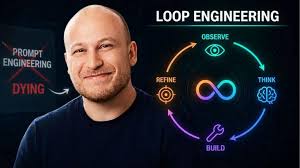
A growing number of AI researchers and engineers are embracing what has become known as “Loop Engineering” — an approach where humans no longer directly instruct AI systems themselves. Instead, they design autonomous systems that continuously prompt, review, and improve AI work on their behalf.
Even the Builders of AI No Longer Prompt AI
Perhaps the strongest signal comes from Anthropic itself. Boris Cherny, the lead developer behind Claude Code, recently made a statement that has sparked significant discussion across the AI engineering community:
“I no longer prompt Claude directly. I have a set of loops that prompt Claude and figure out what needs to be done. My job is simply to write those loops.”
Think about that for a moment. One of the people responsible for building one of the world’s most advanced AI coding systems no longer spends his time manually instructing the AI. Instead, he designs systems that instruct the AI for him.
In the same week, OpenAI engineer Peter Steinberger, creator of the widely discussed OpenClaw project, issued a similarly provocative statement:
“You should stop prompting coding agents.”
According to Google Chrome and Google Cloud engineering leader Addy Osmani, this emerging paradigm now has a name:
Loop Engineering.
From Prompt Engineer to Loop Designer
Traditional prompt engineering assumes a direct relationship between humans and AI systems. A person writes a prompt, waits for a response, reviews the output, and then manually decides what to do next.
Loop engineering abstracts that process. Rather than telling the AI exactly what to do at every step, humans build systems that continuously instruct, monitor, verify, and improve AI outputs automatically. The human becomes less of an operator and more of an architect.
As former OpenAI researcher Andrej Karpathy recently summarized:
“Stop being the bottleneck in the process and maximize your leverage.”
The objective is no longer producing the best prompt. The objective is designing the best system.
What Does Loop Engineering Actually Look Like?
At its core, loop engineering creates an automated feedback cycle between AI agents. While implementations vary, most loop systems contain five core stages.
- The first stage is discovery, where AI agents identify work for themselves by scanning repositories, finding failing tests, locating bugs, or identifying optimization opportunities.
- The second stage is handoff, where each identified task receives its own isolated workspace, allowing multiple agents to work simultaneously without interfering with one another.
- The third stage is verification, which may be the most important component. Separate AI agents review completed work under the assumption that the original output is incorrect. Rather than validating success, their job is to actively search for failure.
- The fourth stage is persistence, where outputs, context, and intermediate decisions are stored so that work can continue across sessions without losing state.
- Finally comes scheduling, where automated timers and event systems restart loops continuously, allowing AI systems to operate for hours, days, or even weeks without requiring direct human intervention.
The result is a workflow where humans define goals while AI systems increasingly determine the path to achieving them.
AI Agents Are Beginning to Manage Other AI Agents
Peter Steinberger recently shared one example of how he uses loop-based workflows:
“Tell codex to maintain your repos, wake up every 5 minutes and direct work to threads. That makes it easy to parallelize and steer work as needed.”
In this model, the human no longer writes prompts throughout the day. Instead, the human supervises an AI system that continuously creates new prompts, reviews outputs, assigns work, and coordinates parallel tasks.
The implications extend far beyond coding.
As agentic AI systems become more capable, loop engineering may become the standard operating model for research, operations, finance, cybersecurity, business analysis, and enterprise workflows more broadly.
Does Loop Engineering Actually Work?
The early evidence suggests that it does. Stripe has reportedly deployed internal pipelines capable of merging more than 1,300 machine-generated pull requests every week, with minimal direct human prompting.
Meanwhile, researchers at the University of Auckland developed a framework called LLMLoop and found that iterative AI feedback loops improved software quality from 76.22% to 90.24% after just five cycles of autonomous review and correction.
These results suggest that one of AI’s greatest strengths may not be producing a perfect answer immediately, but rather continuously improving its own output through repeated iteration.
Why This Changes Everything
For much of the past decade, competitive advantage in software came from building better products. Over the last three years, competitive advantage shifted toward having access to better AI models.
The next competitive advantage may lie somewhere else entirely: building better systems around those models. AI models themselves are rapidly becoming commodities. Open-source models continue improving, inference costs continue falling, and access to frontier capabilities continues expanding.
The real leverage increasingly comes from designing workflows that allow AI systems to coordinate, review, test, and improve themselves autonomously.
In that world, prompt engineering becomes infrastructure. Loop engineering becomes strategy.
The Human Role Isn’t Disappearing. It’s Changing.
None of this means humans disappear from the process. In fact, poorly designed loops can create runaway costs, infinite execution cycles, and increasingly sophisticated errors. Building effective autonomous systems requires careful control of verification mechanisms, stopping conditions, memory systems, and operational constraints.
But the role of the human is changing. Rather than acting as the person writing every instruction, humans become the architects of systems that generate their own instructions.
And according to many of the people building the future of AI, that future has already begun.
Sources: CNBC interview with Boris Cherny; Peter Steinberger (@steipete); Addy Osmani commentary on Loop Engineering; Andrej Karpathy; University of Auckland LLMLoop research; reported Stripe AI engineering workflows.