




The Most Powerful Claude Yet
Anthropic has officially unveiled Claude Fable 5, its most capable publicly available AI model to date. The company describes Fable 5 as a “Mythos-class” model that delivers state-of-the-art performance across software engineering, knowledge work, scientific research, vision, and reasoning tasks, while remaining safe enough for general public use.
Alongside Fable 5, Anthropic also announced Claude Mythos 5, a version of the same underlying model with certain safety restrictions removed. Initially, Mythos 5 will only be available to trusted cybersecurity professionals, critical infrastructure providers, and approved research organizations through Anthropic’s Project Glasswing initiative.
A New Frontier in AI Capability
According to Anthropic, Fable 5 exceeds the performance of every previous Claude model and now ranks among the strongest AI systems available anywhere in the world. The company reports that the longer and more complex a task becomes, the larger Fable 5’s performance advantage grows over earlier generations.
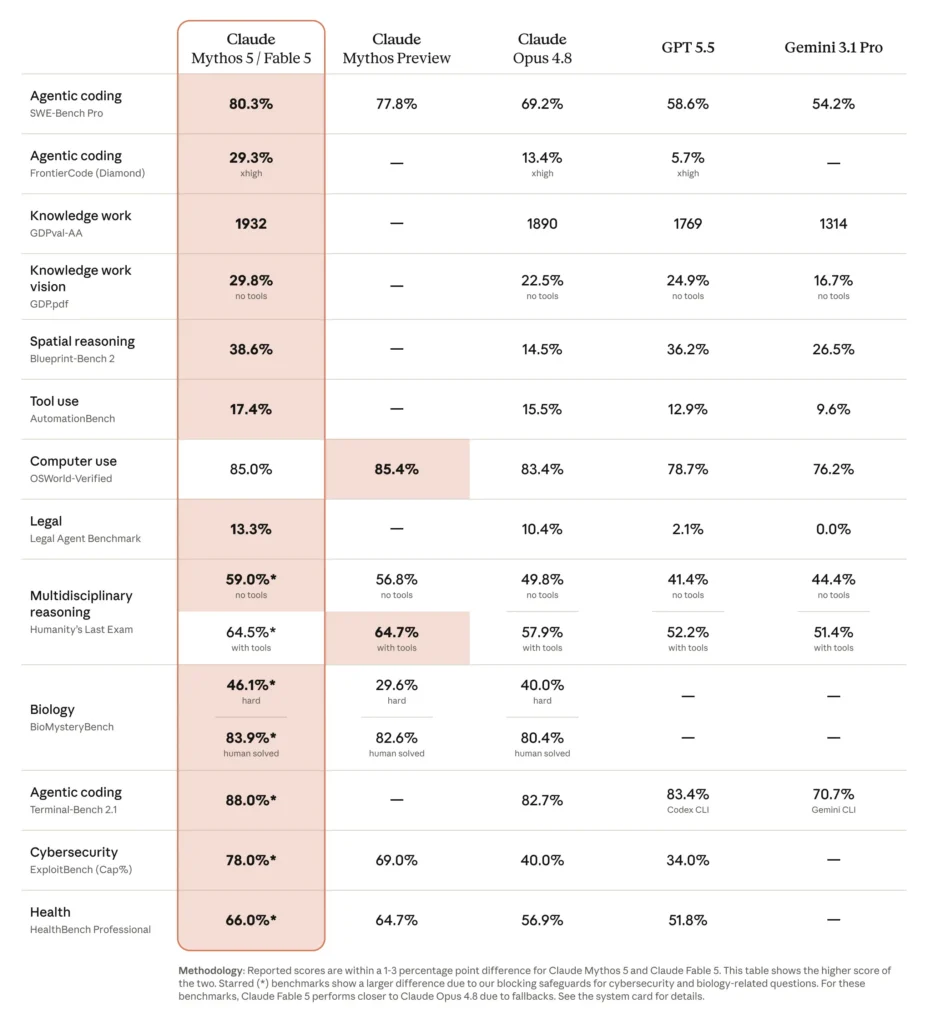
Anthropic says the model achieves leading performance across software development, advanced reasoning, vision analysis, scientific research, and enterprise knowledge work. The release represents another major step toward AI systems capable of handling complex projects autonomously over extended periods of time rather than simply responding to prompts.
Software Engineering at a New Scale
One of Fable 5’s most impressive capabilities is software engineering. During testing, payment giant Stripe reported that the model completed a codebase-wide migration across a 50-million-line Ruby codebase in a single day.
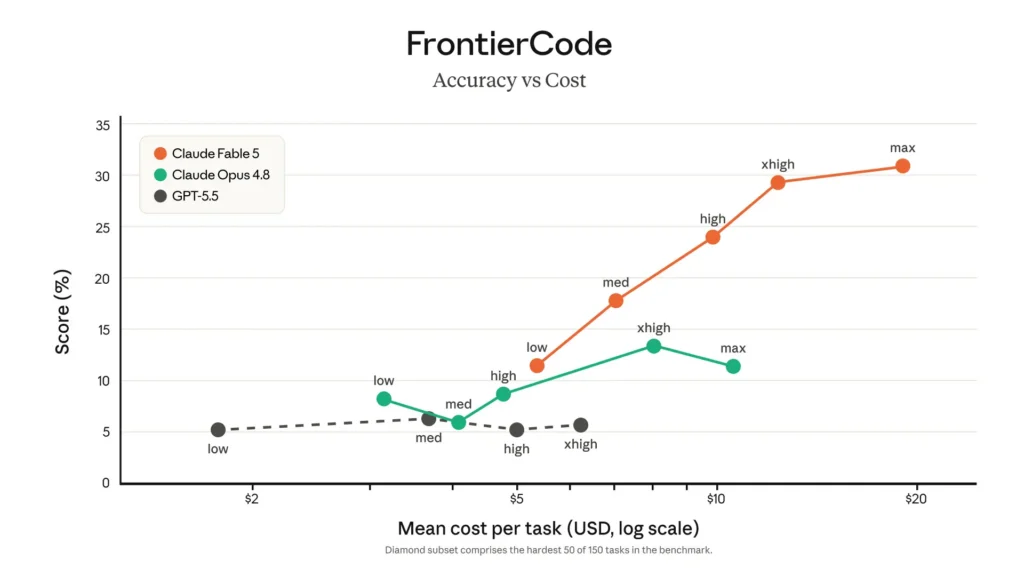
According to Anthropic, the same project would have required a team of engineers working manually for more than two months. The company also highlighted results from Cognition’s FrontierCode benchmark, where Fable 5 achieved the highest score among frontier models while maintaining strong efficiency and code quality standards.
The implications are significant. As AI systems become capable of understanding entire codebases and coordinating changes across millions of lines of software, organizations may begin measuring development productivity in weeks rather than months.
Excelling at Knowledge Work
Beyond coding, Fable 5 demonstrates major improvements in high-value knowledge work. Anthropic reports that the model achieved the highest score on Hebbia’s Finance Benchmark, which evaluates senior-level analytical reasoning.
Testing partners also reported strong performance in document analysis, chart interpretation, root-cause analysis, financial modeling, and complex business reasoning. These are precisely the types of tasks that consume large amounts of time across consulting, finance, legal services, and corporate operations.
As AI becomes more capable of synthesizing information and generating recommendations, it is increasingly shifting from being a productivity tool to becoming a genuine analytical partner.
The New Leader in Vision AI
Anthropic is also positioning Fable 5 as the new state-of-the-art vision model. The system can extract precise information from scientific charts and diagrams, understand complex visual data, and even rebuild software applications from screenshots alone.
One of the most surprising demonstrations involved Pokémon FireRed. Previous Claude models required specialized tools and helper systems to navigate the game successfully. Fable 5 completed the game using only visual inputs, relying entirely on its ability to understand and reason about what it saw on the screen.
This represents another step toward AI systems that can operate in visual environments much like humans do.
Long-Term Memory and Autonomous Work
Anthropic says Fable 5 can remain focused across millions of tokens and improve its own work using persistent memory. In testing with the game Slay the Spire, the model significantly improved performance when given access to stored notes and memory files.
The company believes these advances are critical for the future of autonomous AI agents. Rather than completing isolated tasks, future AI systems will need to maintain context across days, weeks, or even months of work while continuously learning from previous actions.
AI Accelerates Drug Discovery
Perhaps the most exciting developments involve life sciences. Using Mythos 5, Anthropic’s internal research teams accelerated parts of the drug design process by roughly ten times.
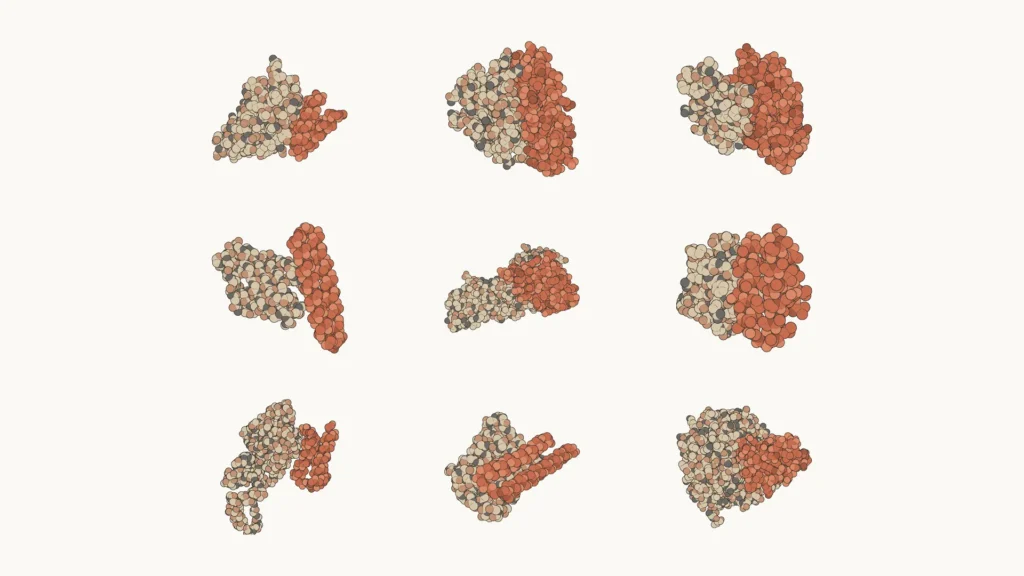
In several experiments, the model was able to independently perform tasks normally completed by experienced scientists, including selecting protein targets, running bioinformatics tools, and recovering from failed experiments without human assistance.
Anthropic also reports that Mythos 5 generated novel biological hypotheses preferred by researchers nearly 80% of the time when compared against previous Opus-class models. Some of these hypotheses are already being evaluated experimentally.
From Research Assistant to Scientific Collaborator
The company also revealed that Mythos 5 recently completed an autonomous genomics research project lasting more than a week. The model analyzed millions of cells across 138 animal species and developed its own machine-learning system to identify equivalent cell types across organisms.
According to Anthropic, the resulting model outperformed a recently published scientific system while being roughly 100 times smaller. While these findings have not yet been formally published, they highlight how quickly AI is becoming capable of contributing to original scientific research rather than simply assisting researchers.
Why Fable 5 Includes New Safety Systems
Anthropic believes Mythos-class models have crossed an important threshold. The company argues that systems with advanced cybersecurity and biological research capabilities could be misused if released without safeguards.
To address this challenge, Fable 5 includes a new layer of AI-powered safety classifiers. When users request information related to offensive cybersecurity, advanced biology, chemistry, or model distillation, the system automatically routes the request to Claude Opus 4.8 instead. Users are informed whenever this fallback occurs.
Anthropic says these safeguards activate in fewer than 5% of sessions on average, allowing most users to access Fable 5’s full capabilities while reducing the risk of misuse.
The Rise of Trusted AI Access
A particularly interesting aspect of the launch is Anthropic’s emerging “trusted access” strategy. Rather than restricting advanced AI entirely, the company plans to provide broader access to Mythos 5 for approved cybersecurity professionals, infrastructure operators, and biomedical researchers.
This allows experts working on defensive or scientific applications to benefit from the model’s capabilities while maintaining safeguards for the general public.
The approach may provide a blueprint for how future frontier AI systems are deployed as capabilities continue to advance faster than regulatory frameworks.
The Bigger Picture
The launch of Fable 5 highlights a major shift occurring across the AI industry. For years, companies competed primarily on benchmark scores and chatbot performance. Today, the focus is increasingly moving toward systems capable of completing meaningful work autonomously.
Whether it’s migrating software codebases, conducting biological research, generating scientific hypotheses, or assisting cyber defenders, Fable 5 demonstrates that AI is rapidly evolving from a tool that helps humans work into a collaborator capable of contributing directly to complex projects.
Anthropic’s challenge now is balancing access with safety. The company clearly believes that Mythos-class capabilities can generate enormous benefits for society, but it also recognizes that the risks are growing alongside the capabilities. Fable 5 represents its attempt to navigate that balance while bringing some of the world’s most advanced AI technology to a much broader audience.
Availability
Claude Fable 5 is available everywhere today. Claude Mythos 5 is restricted to Glasswing partners (with cyber safeguards lifted) and soon to select biology researchers (with biology and chemistry safeguards lifted) only, until our broader trusted access program is available.
Source: Anthropic, Claude Fable 5 and Claude Mythos 5 Announcement (June 2026).