The AI coding wars are entering a new phase. For the last two years, most AI developer tools have functioned like copilots—helpful assistants that generate snippets of code, explain functions, or autocomplete workflows. With the launch of Grok Build, xAI is making a much bigger bet: that the future of software engineering belongs to autonomous coding agents capable of planning, executing, debugging, and managing projects end-to-end.
Positioned as a direct competitor to tools like Anthropic’s Claude Code, Grok Build is more than a coding chatbot running in a terminal. According to xAI, the system can independently research problems, design solutions, write and review code, deploy projects, and even coordinate multiple subagents working in parallel. The company describes it as a “powerful new coding agent and CLI for professional software engineering and complex coding work.”
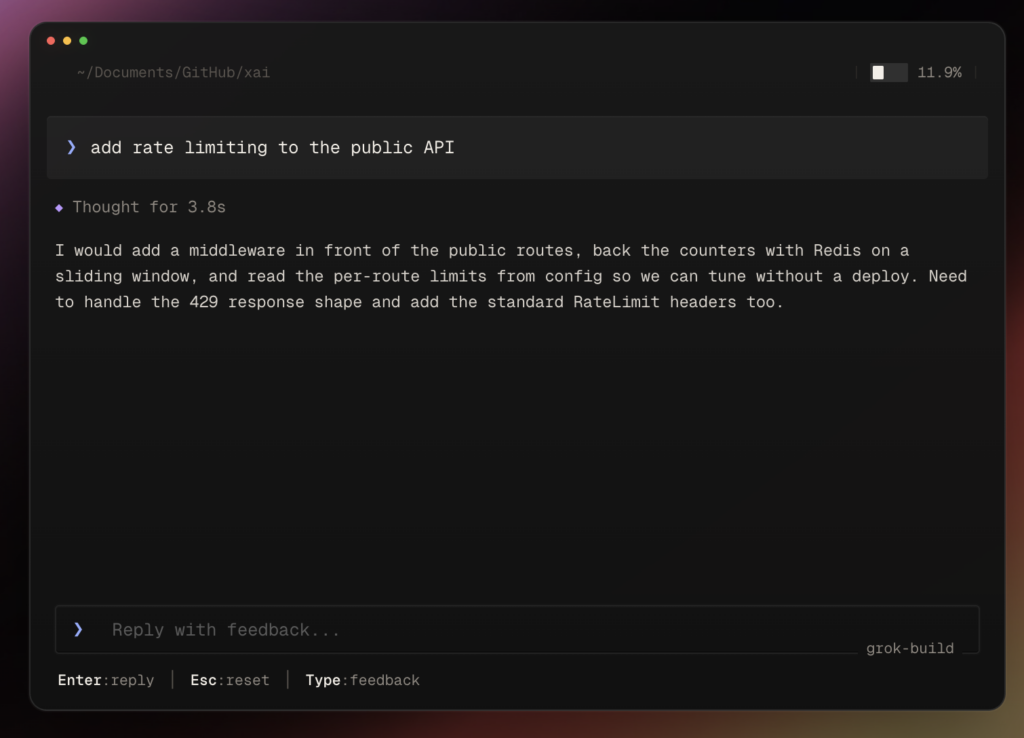
That distinction matters because the market is rapidly shifting away from simple prompt-response interactions toward agentic AI systems that can sustain workflows over long periods of time. Grok Build is designed to operate autonomously in the background for hours or even days, splitting tasks into subagents, integrating directly into repositories, and using external tools and MCP servers to inspect live infrastructure. In practical terms, this starts to look less like an assistant and more like a junior engineering team.
The Rise of Parallel AI Workers
One of the most important features demonstrated in Grok Build is its ability to launch parallel subagents that independently investigate different aspects of a problem. In one example, the system simultaneously explored deploy histories, slow endpoints, database query plans, cache hit rates, and infrastructure logs to identify the source of a p99 latency regression.
That workflow is significant because it mirrors how modern engineering teams actually operate. Large software problems are rarely solved through single-threaded reasoning. They require distributed investigation, context sharing, and iterative diagnosis across systems.
This is where the AI industry appears to be heading. The next generation of models may not simply answer questions—they may coordinate teams of AI workers specialized for different tasks.
AI Is Becoming Infrastructure, Not Software
Perhaps the most interesting part of Grok Build is not the coding itself, but the operating model behind it. The platform integrates with existing repositories, plugins, hooks, skills, and MCP servers, while supporting headless operation for automation pipelines.
That signals a larger shift happening across AI: models are evolving from standalone applications into infrastructure layers embedded directly into workflows. In the future, developers may spend less time writing code manually and more time orchestrating AI systems that generate, test, debug, and optimize software continuously.
This is why the terminal matters. The command line has historically been the domain of professional developers and systems engineers. By bringing autonomous AI directly into that environment, xAI is positioning Grok Build not as a consumer toy, but as a professional engineering platform.
The Pressure on Human Developers Intensifies
The broader implication is difficult to ignore. As coding agents become more autonomous, the economics of software development begin to change.
A single engineer equipped with powerful AI agents may eventually accomplish the work of entire teams for certain categories of development. Routine implementation, documentation, debugging, testing, and maintenance work could increasingly become machine-driven processes supervised by humans rather than executed by them directly.
This does not necessarily eliminate developers, but it does redefine the role. Engineers may increasingly act as architects, reviewers, and orchestrators rather than line-by-line coders. In that world, the most valuable skill may no longer be writing syntax—it may be managing systems of intelligence.
xAI’s High-Stakes Catch-Up Game
The launch also reflects the pressure inside xAI itself. Elon Musk has publicly acknowledged that the company fell behind rivals like Anthropic and OpenAI in coding performance. Reports suggest internal efforts have focused heavily on catching up to Claude’s software engineering capabilities, with Grok Build representing a direct attempt to close that gap.
At the same time, xAI continues to face scrutiny around governance, safety, and organizational stability. The company’s models have previously generated controversy over harmful image generation and moderation failures, while reports of employee departures have raised questions about execution risk inside the broader SpaceXAI organization. Yet despite those concerns, Grok Build demonstrates something important: the competitive frontier in AI is rapidly moving from models that can converse to systems that can act.
The Bigger Picture
The launch of Grok Build reinforces a trend now visible across the industry. AI is evolving from passive intelligence into operational intelligence. The first AI boom gave us systems that could generate text, the second wave is giving us systems that can perform work. That transition may ultimately prove far more disruptive—not only for software engineering, but for knowledge work as a whole.
Because once AI agents can coordinate tasks, manage workflows, use tools, and operate autonomously over time, the question is no longer whether AI can assist professionals. It becomes how many professionals are still needed.
Sources: xAI Grok Build launch materials and early beta documentation; reporting by Engadget on Grok Build and xAI strategy (2026).