





OpenAI has introduced GPT-Rosalind, a new AI model specifically designed to accelerate research in life sciences, including biology, drug discovery, and translational medicine. Unlike general-purpose AI systems, GPT-Rosalind is optimized for scientific workflows, with deeper capabilities across chemistry, genomics, and protein engineering. The goal is to help researchers navigate complex scientific processes more effectively and unlock new breakthroughs faster.
Drug development today is a slow and expensive process, often taking 10 to 15 years from initial discovery to regulatory approval. Much of this delay comes from fragmented and time-intensive workflows, where scientists must analyze vast amounts of data, literature, and experimental results. GPT-Rosalind aims to streamline these early stages by improving how researchers generate hypotheses, interpret data, and design experiments—areas where early gains can significantly impact downstream success.
“The life sciences field demands precision at every step. The questions are highly complex, the data are highly unique, and the stakes are incredibly high. Our unique collaboration with OpenAI enables us to apply their most advanced capabilities and tools in new and innovative ways with the potential to accelerate how we deliver medicines to patients.”
—Sean Bruich, Senior Vice President of Artificial Intelligence and Data, Amgen
The model is built to go beyond simple efficiency improvements. It supports multi-step scientific reasoning, helping researchers uncover hidden connections, explore more possibilities, and make better-informed decisions. By assisting with tasks like evidence synthesis, experimental planning, and data analysis, GPT-Rosalind has the potential to increase both the speed and success rate of scientific discovery, enabling breakthroughs that may not have been possible using traditional methods.
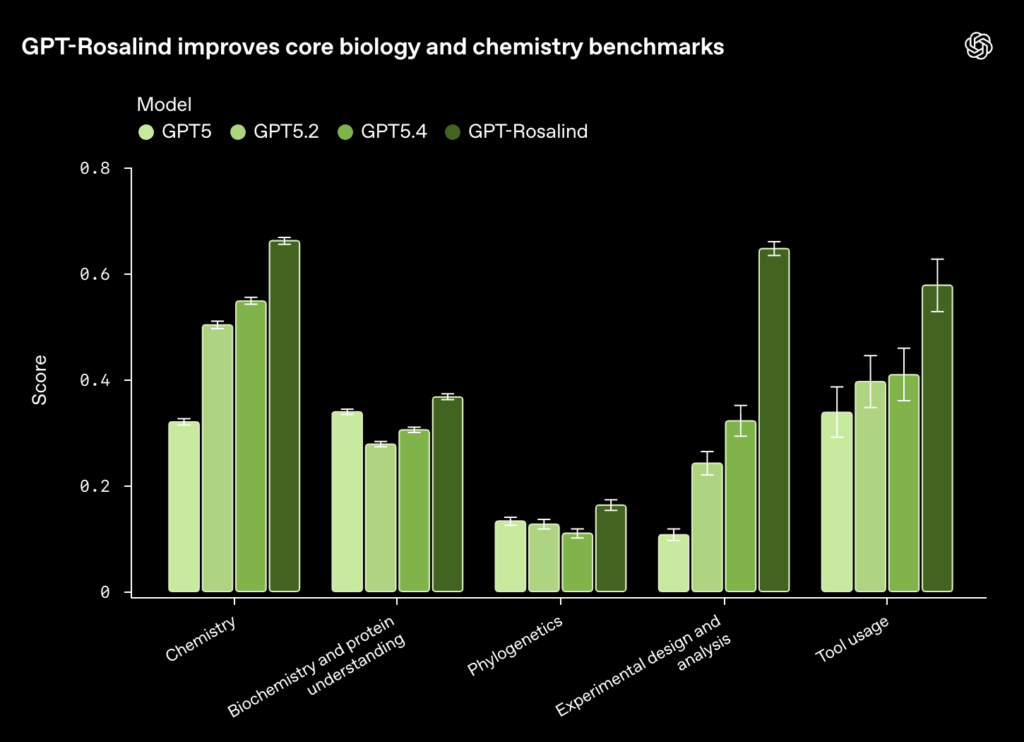
GPT-Rosalind is currently available through a controlled research preview for qualified organizations, alongside a new Life Sciences plugin that connects to over 50 scientific tools and databases. OpenAI is already collaborating with leading institutions such as Amgen, Moderna, and the Allen Institute to apply the model in real-world research environments. Early evaluations show strong performance across key scientific benchmarks, including chemistry, genomics, and experimental design, with results that rival or exceed human experts in certain tasks.
Looking ahead, GPT-Rosalind represents the first step in a broader effort to build AI systems that act as true partners in scientific discovery. With continued development, these models could help researchers move more quickly from data to insight—and ultimately from insight to life-saving treatments. The model is named after Rosalind Franklin, honoring her foundational contributions to understanding DNA and modern molecular biology.
Reference: OpenAI – Introducing GPT-Rosalind for life sciences research
Find out more