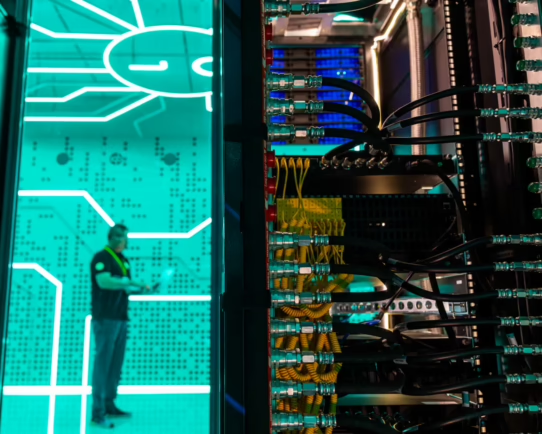






AI Companies Are No Longer Just Building Models. For the past several years, the AI race has been dominated by models. Companies competed to build larger language models, better reasoning systems, and more capable AI assistants. Today, the battleground is shifting beneath the software layer and into the infrastructure itself.
OpenAI has announced Jalapeño, its first custom AI inference chip developed in partnership with Broadcom. The move represents a major milestone in OpenAI’s strategy to build a full-stack AI platform spanning models, products, infrastructure, and now custom silicon. (GlobeNewswire)
Why OpenAI Is Building Its Own Chips
Running AI models at scale has become one of the most expensive challenges in technology. Every ChatGPT conversation, AI agent interaction, and enterprise deployment requires massive amounts of compute power.
Historically, OpenAI has relied heavily on GPUs from NVIDIA. However, growing demand for AI infrastructure has created supply constraints across the industry. By designing its own inference hardware, OpenAI gains greater control over costs, performance, and future scalability while reducing dependence on external suppliers. (Axios)
Built Specifically for AI Inference
Unlike training chips that teach AI models, Jalapeño is designed for inference—the process of generating responses, running AI agents, and serving applications such as ChatGPT and Codex.
According to OpenAI and Broadcom, the chip was developed from design to production in just nine months and is optimized specifically for large language model workloads. Early testing suggests Jalapeño delivers significantly better performance-per-watt than current state-of-the-art solutions, a critical metric as AI infrastructure increasingly faces both cost and energy constraints. (GlobeNewswire)
The Rise of the Full-Stack AI Company
The announcement highlights a broader trend emerging across the industry. OpenAI is following a path already explored by companies such as Google, Amazon, Microsoft, and Meta, all of which have invested heavily in custom AI hardware.
The reasoning is simple: as AI becomes a core utility, competitive advantage no longer comes solely from having the best model. It comes from controlling the entire technology stack—from data centers and networking to chips, models, and end-user products. OpenAI’s Jalapeño processor is the latest step in building that vertically integrated future. (OpenAI)
What This Means for Enterprise AI
For enterprises, this development matters because infrastructure ultimately determines the economics of AI. Better performance-per-watt means lower operating costs, faster response times, and the ability to deploy AI at larger scale.
If custom accelerators like Jalapeño deliver on their promise, they could help make advanced AI services cheaper and more accessible across industries. Tasks that are currently expensive to automate may become economically viable, accelerating the adoption of AI agents, copilots, and enterprise automation platforms. (Stock Titan)
The Real Story Is Control
The most important takeaway is not that OpenAI built a chip. It is that AI companies increasingly view infrastructure as strategic.
The first generation of AI was about who could build the best models. The next generation may be decided by who controls the hardware, networking, energy, and compute capacity needed to run those models at global scale. Jalapeño is OpenAI’s clearest signal yet that the future of AI will be won not just in software, but across the entire technology stack. (GlobeNewswire)
Source: OpenAI & Broadcom, OpenAI and Broadcom Unveil LLM-Optimized Intelligence Processor (June 2026), plus reporting from Reuters and The Verge. (GlobeNewswire)