





For decades, the idea of machines reading human thoughts has belonged firmly in the realm of science fiction. But advances in artificial intelligence and neuroscience are beginning to challenge that assumption. Researchers are now developing systems that can analyse patterns of brain activity and reconstruct elements of what a person is thinking, imagining or hearing—raising both exciting possibilities and profound questions about privacy and the future of human-machine interaction.
At the centre of this research are brain–computer interfaces (BCIs), technologies that create a direct communication link between the brain and an external computer. These systems measure brain activity using tools such as electroencephalography (EEG) or functional MRI scans, then use machine-learning algorithms to interpret the patterns they detect. Instead of relying on speech or physical movement, BCIs can translate neural signals directly into digital commands or text. (Wikipedia)
In recent experiments, scientists have combined brain-scanning data with powerful AI language models. By analysing how specific patterns of neural activity correspond to language or images, these systems can generate descriptions of what a participant is hearing, seeing or imagining. Rather than decoding exact words, the technology often captures the meaning of a thought—producing sentences that closely match the ideas passing through a participant’s mind.
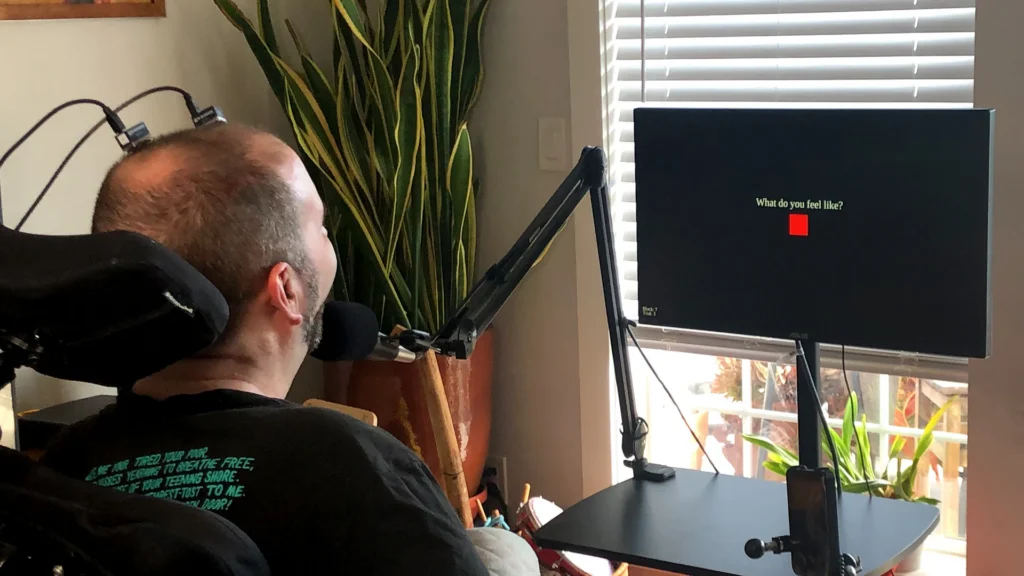
One of the most promising uses for this technology lies in medicine. People who have lost the ability to speak due to stroke, paralysis or neurological disease could one day communicate again using brain signals alone. In these scenarios, AI systems act as translators, converting neural activity into text or synthetic speech and restoring a fundamental human ability: the power to express one’s thoughts.
Yet the possibility of decoding the mind also raises serious ethical concerns. If technology can interpret brain activity, questions quickly emerge about who owns that data and how it might be used. Brain signals could potentially reveal deeply personal information, from memories to emotional states. Researchers therefore stress that current systems require cooperation, specialised equipment and careful training, meaning they cannot secretly read minds. Even so, many experts argue that new legal protections for cognitive privacy may eventually be needed.
For now, the technology remains in its early stages. Today’s systems can infer general meaning or reconstruct images under controlled laboratory conditions, but they are far from decoding the full complexity of human thought. Still, the trajectory is clear. As artificial intelligence becomes better at interpreting patterns in vast amounts of data, the boundary between mind and machine may continue to blur.
What once seemed impossible—computers understanding the silent language of the brain—may gradually become one of the most transformative frontiers of modern science.
Read the full article at BBC here
https://www.bbc.com/future/article/20260226-how-ai-can-read-your-thoughts